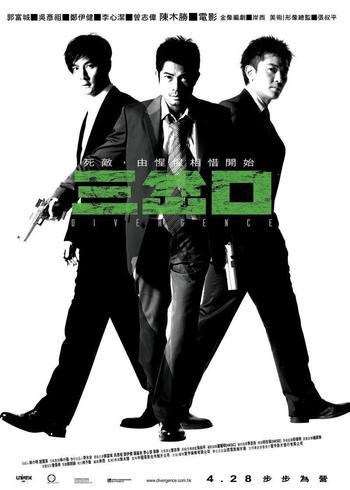
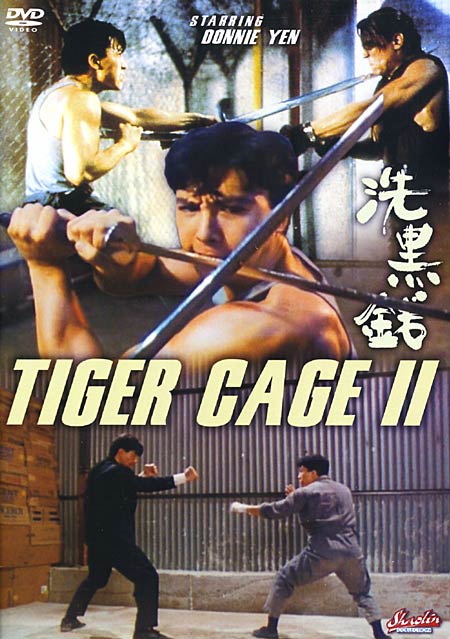
WHAT PRICE SURVIVAL (1994) review

The one-armed sworsman is a fixture of Chinese cinema, from the original Shaw Brothers trilogy directed by Chang Cheh and starring first Wang Yu, then David Chiang, to countless crossovers (including Zatoichi vs. the One-armed Swordsman) and variants (for instance The One-armed Swordsmen or The One-armed Swordswoman). But by 1994, when Daniel Lee’s What Price Survival was released, it had all but disappeared, due in part to the fact it had been done to death, and in part to the fact that Wu Xia Pan’s and costumed epics in general weren’t that popular anymore during the eighties.

What Price Survival is Daniel Lee’s very first film and, as he wrote it, one of his most personal. Its setting is contemporary, but in a timeless way by which people still carry swords. Visually, as with any Daniel Lee film (save for the odious Black Mask), it is a treat : gorgeous snowy landscape captured by Lee’s DP of choice Tony Cheung, dozens of men in black long coats wielding swords, two lovers playfully fighting through lonely rays of light in an abandoned mansion… Narratively however, the struggle for coherence begins.
(more…)

TIGER CAGE 2 (1990) review

In the eighties, director and martial arts choreographing god Yuen Woo Ping was trying to push forward in the limelight one of his most gifted disciples, Donnie Yen. First, Yen worked for Yuen as a stuntman, then the pair collaborated on three urban action films under the banner of the ill-fated D&B Films Company: Tiger Cage, In The Line Of Duty 4 and Tiger Cage 2. The latter only has a vague thematic kinship to Tiger Cage: it is not properly speaking a sequel, as Donnie Yen doesn’t even play the same character. Or does he? The truth is, in those late-eighties thrillers Yen always played more or less the same character: a tough, naively macho cop, with an almost childish inability to properly communicate with women. Here he is surrounded with a fairly interesting cast including Shaw Brothers legend Lo Lieh, future Once Upon A Time In China star Rosamund Kwan, the highest-paid actress in Hong Kong (at the time) Carol “Do-Do” Cheung, as well as the Michelle Yeoh-wannabe Cynthia Khan and Robin Shou of Mortal Kombat fame.

(more…)

THREE KINGDOMS: RESURRECTION OF THE DRAGON (2008) review

The Romance of the Three Kingdoms, the historical novel written by Luo Guanzhong in the 14th century and chronicling the years of constant warfare between kingdoms that marked the end of the Han Dinasty from 169 to 280, has always been the source of many films and TV series, most notably John Woo’s Red Cliff parts I & II, and a few months ago the Donnie Yen vehicle The Lost Bladesman. A sprawling epic, it provides a bonanza of characters, events and battles, which means filmmakers can always come back to the tried and tested Three Kingdoms source material, each time focusing on a different set of characters or a different chunk of the storyline.

Daniel Lee’s Three Kingdoms : Resurrection of the Dragon follows Zhao Zilong, one of the “Five Tiger Generals” of the Shu Kingdom. The film fashions itself as a biopic of sorts, but takes more than a few liberties with the source material, which itself is already semi-mythical. We follow Zhao Zilong (Andy Lau) from his enlisting in the Shu army, where he forms a long-standing friendship with Luo Ping An (Sammo Hung Kam-Bo), to his becoming a general nicknamed “The Invincible”, to his heroic death during the Battle of the Phoenix Heights, where his outnumbered army was annihilated by Cao Ying’s (Maggie Q) Wei Army.

(more…)

PHANTOM: THE SUBMARINE (1999) review

Submarine films don’t come often: the last significant one was David Twohy’s superb Below in 2003 (and, the same year, Kathryn Bigelow’s underrated K-19: The Widowmaker). Asian submarine films are even more scarce. In fact, I can’t think of one on the top of my head. Phantom: The Submarine thus has some measure of novelty to it. Directed by Min Byung-Chun and written by the great Bong Joon-Ho (of The Host and Memories of Murder fame, among others), it stars Jun Woo-Sung and Choi Min-Soo. The plot is kind of a cross between The Hunt for Red October and Crimson Tide: a nuclear submarine commander (Choi Min-Soo) decides to go rogue and threatens to bomb a nearby country (here Japan), like Sean Connery in Red October. But not everyone agrees with him aboard the ship, which leads to a face-off between the commander and one of the officers (Jun Woo-Sung), like Gene Hackman and Denzel Washington in Crimson Tide. But Phantom: The Submarine has a tone all of its own, sometimes verging on the supernatural. The submarine in the film is called Phantom for one good reason: it’s not supposed to exist, and everybody in its crew is supposed to be dead. For instance Jun Woo-Sung’s character was supposed to be executed, but instead got assigned to the submarine as a weapons officer, under the number (names and personal items are forbidden) 431. So it’s basically the contemporary, realistic equivalent of a ghost ship.

(more…)

SILVER HAWK (2004) review

Following her rise to international fame thanks to Crouching Tiger, Hidden Dragon, Michelle Yeoh founded Mythical Films with her then-companion Thomas Chung, with an eye towards giving herself tailor-made roles in films with an international ambition. The venture led to Peter Pau’s The Touch, a sporadically enjoyable Indiana Jones-wannabe that was successful in China but not anywhere else, and to Silver Hawk, which replicated The Touch’s pattern of success. Both films are vanity projects of sorts for Yeoh, as she cast herself first as a fearless adventurer then as a fearless super-heroine, in films that glorified the grace of her moves and the flawlessness of her skin. Not that there’s anything wrong with the idea of a film glorifying Michelle Yeoh. One of the most beautiful actresses in the world, a skillfull martial artists of unparalleled grace in action, but also a powerful dramatic actress (as evidenced in films like the aforementioned Ang Lee film and Far North, among many others), Yeoh is the very definition of a true movie star. But the cold, hard truth is that Silver Hawk is as misguided a star vehicle as it gets.

(more…)

ISLAND OF FIRE (1990) review

The most obvious thing Island of Fire has going for it, is its cast : Jackie Chan, Sammo Hung Kam-Bo, Andy Lau, Jimmy Wang Yu, and Tony Leung Ka-Fai. This is, absolutely speaking, one hell of a line-up, but of course at the time Andy Lau, though having been in countless films already, was still more successful as a singer than an actor, Sammo Hung was on the decline after his break-up with the almighty Golden Harvest Studio, Jimmy Wang Yu was nearing his self-imposed exile from films, and Tony Leung Ka-Fai had never had a leading role before. All in all, Jackie Chan was the only member of the cast to truly be at the height of his popularity (a height he has barely left ever since). However, Chan is not the lead here : Leung is, and even he is sidelined for entire chunks of the film. Actually, if there was to be a real leading role here, it would be the island itself, or rather the prison that is on this island.

(more…)

DIVERGENCE (2005) review

Benny Chan’s Divergence proceeds directly from the overwhelming and international success of the Infernal Affairs trilogy. It is not a cash-in, mind you : the kinship here is mainly to be seen in the tight storytelling refusing to be overly explanatory, the cold urban aesthetics and the stellar cast. The Hong-Kong superstar Aaron Kwok plays Suen, a cop whose girlfriend disappeared 10 years ago, and who’s never stopped looking for her, including at the morgue. He has been assigned to the protection of a key witness in the high-stakes trial of a corrupt businessman. The businessman’s lawyer (portrayed by Ekin Cheng) happens to be married to a woman looking remarkably like his long-lost girlfriend. That, coupled with the fact that the witness gets killed by a hitman called Coke (played by Daniel Wu), triggers a chain of events that put Suen’s mental and physical health to the test.

(more…)