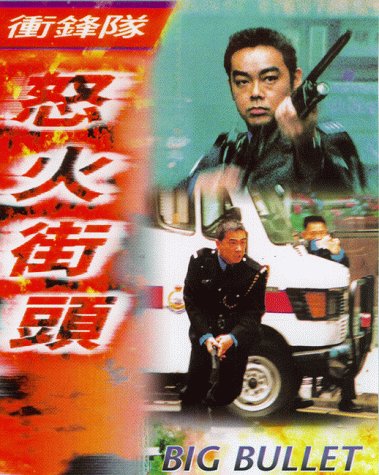
Bill Chu (Lau Ching Wan), a dedicated but headstrong Hong Kong cop, is demoted to the Emergency Unit for having punched his incompetent commanding officer during a police raid gone awry. There, he butts heads with by-the-book cop Jeff Chiu (Jordan Chan), and keeps trying to stop a gang of international criminals headed by Anthony Wong Chau-Sang and Yu Rongguang. There’s nothing new in this plotline, but there’s Benny Chan behind the camera, a superb cast in front, and a better-than-average script to tie it all in. Today Benny Chan is one of the top directors in Hong Kong and China, but in the middle of the nineties, having been revealed by the A Moment of Romance films, he was only starting to get to really shine, with main HK luminaries such as John Woo, Ringo Lam, Kirk Wong and Tsui Hark off to the United States. Although Big Bullet was a hit in Hong Kong at the time, it is strangely forgotten today, and never crossed over to the West as other HK action films have.
All posts in category Film Reviews
BIG BULLET (1996) review
Posted by LP Hugo on January 29, 2012
https://asianfilmstrike.com/2012/01/29/big-bullet-1996-review/
LAST HERO IN CHINA (1993) review
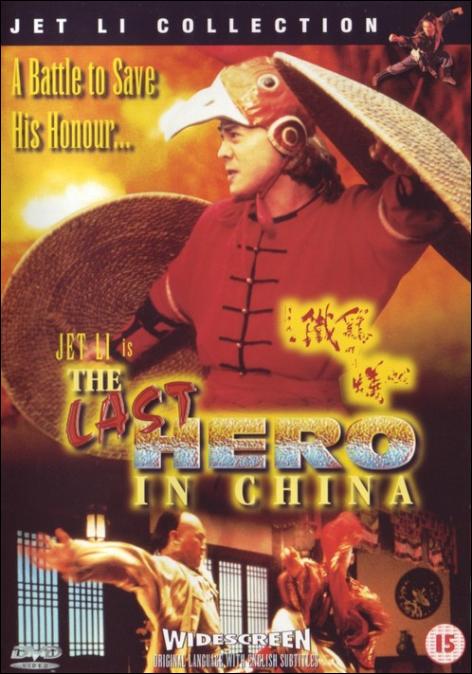
In 1993, near the end of production on Tsui Hark and Jet Li’s third installment in the insanely successful Once Upon A Time In China series, there seemingly was some kind of dispute between director and star, which led to the two not working together for more than a decade, despite their working relationship being as legendary as, say, John Woo and Chow Yun Fat. It also led to Jet Li leaving the Once Upon A Time In China franchise (and being replaced with Vincent Zhao). But less than a year later, Li took the role of Wong Fei-Hung again, in a non-official installment : Last Hero in China.
In a way, Last Hero in China (also called Claws of Steel in some places), is to Jet Li what Never Say Never Again is to Sean Connery: both a loving hommage and a cheeky send-up of the character that made him a superstar. A cheeky send-up, in part because the director is none other than Wong Jing, the ‘master’ of heavy and greasy Hong Kong comedy, but a loving homage, because beneath the comedy, there is still Master Wong’s impeccable mastery of Wushu, choreographed by the great Yuen Woo-Ping (just like the first two Once Upon A Time In China films).
Posted by LP Hugo on January 1, 2012
https://asianfilmstrike.com/2012/01/01/last-hero-in-china-1993-review/
PAINTED SKIN (2008) review
Wang Sheng (Chen Kun) is a general who rescues a young woman named Xiao Wei (Zhou Xun) during a raid against desert bandits. Hearing that she is alone in the world he takes her as one of his household’s servants back home. But quickly after her arrival, people are found dead in the city, their hearts ripped off. Wang’s wife Peirong (Zhao Wei) suspects Xiao Wei, but the latter has won everyone over with a kindness. When Wang’s brother Pang Yong (Donnie Yen) comes back from a two-year absence, Peirong begs him to investigate the matter, which he does, with the help of Xia Bin (Sun Li), a young woman pretending to be a “demon-buster”. Adapted from Pu Songling’s short stories in Strange Stories from a Chinese Studio, Gordon Chan’s Painted Skin was a big hit in Asia, as well as Hong Kong’s submission for the Foreign Language Film Oscar in 2008. But this latter bidd for worlwide recognition fell flat, and understandably so : Gordon Chan’s film is a ghost story, but one that follows conventions quite alien to western ones.
Posted by LP Hugo on December 13, 2011
https://asianfilmstrike.com/2011/12/13/painted-skin-2008-review-2/
THE LEGEND OF SPEED (1999) review
In the years following the 1997 retrocession of Hong Kong, when there were concerns over the fate of the Hong Kong film industry, one artistic collaboration was a beacon of hope, churning out nearly two films every year, most of them big hits : director Andrew Lau and actor/singer Ekin Cheng. Hot off the considerable success of Storm Riders and A Man Called Hero, they again collaborated on The Legend of Speed in 1999. It is surprising to see how similar The Legend of Speed is to the Fast & Furious films, and at the same time to note that Andrew Lau’s film actually pre-dates Rob Cohen’s first installment of the famous street-racing franchise. So this is not a case of Hong Kong cinema ripping off Hollywood successes. But the basic ingredients are the same : bad boys going toe to toe in street races, surrounded by hot babes. The main difference would be that there is no criminal dimension in The Legend of Speed ; it is more of a genuine sports film.
Posted by LP Hugo on December 11, 2011
https://asianfilmstrike.com/2011/12/11/the-legend-of-speed-1999-review/
LEGENDARY ASSASSIN (2008) review
With Jackie Chan, Jet Li and Donnie Yen approaching their fifties or even sixties, and looking to extend their acting ability as a way of staying relevant (which all three did superbly), the world of movie martial arts has been in dire need of a new beacon. For a while it looked like Tony Jaa was the heir apparent, with films like Ong Bak 1 & 2 and Tom Yum Goong displaying his amazing abilities. But his output has been both surprisingly sparse and strangely compromised by shady ties with the Thaï mob. But one other name deserves mention, that of Jacky Wu Jing. Wu was spotted in the mid-90’s by the great Yuen Woo Ping, but apart from two minor films, he didn’t do much in that decade to get himself known. But at the beginning of the noughties, he started cropping up in a variety of supporting roles where he more often than not played the “silent but deadly henchman with a strange hairstyle”. Films such as Wilson Yip’s S.P.L. (where his alley fight against Donnie Yen became an instant classic), Benny Chan’s Invisible Target and Dennis Law’s Fatal Move firmly put him on the map, but in order to really leave a mark, he would have to become a leading man, and Legendary Assassin was in 2008 his second attempt at that (the first one being Dennis Law’s Fatal Contact in 2006).
Posted by LP Hugo on November 20, 2011
https://asianfilmstrike.com/2011/11/20/legendary-assassin-2008-review/
ROYAL WARRIORS (aka IN THE LINE OF DUTY 2) (1986) review
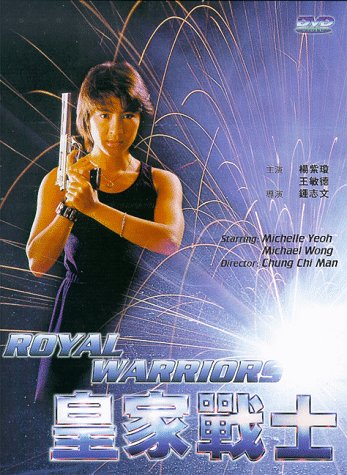
Royal Warriors, also known as In The Line Of Duty, was at the time Michelle Yeoh’s second fully-fledged film role (after bit parts in two Sammo Hung films) ; the first one had been Yes Madam!, where she had more of a supporting role next to Cynthia Rothrock, but had one or two big fight scenes. So it’s safe to say Royal Warriors, where Yeoh has top-billing, was the real introduction to her talent(s). Directed by David Chung (who would direct Yeoh once again the following year in Magnificent Warriors), Royal Warriors is about a cop (Yeoh), an Japanese ex-cop (Hiroyuki Sanada) and an air security agent (Michael Wong) who together foil the hijacking of a plane, by killing the two persons who attempted it. As a result, two blood brothers of the killed hijackers swear revenge on the ‘heroic trio’. The plot is fairly simple, but the film does a number of things much better than a lot of Hong Kong action films of the time (like Tiger Cage 2, for instance).
Posted by LP Hugo on November 10, 2011
https://asianfilmstrike.com/2011/11/10/royal-warriors-aka-in-the-line-of-duty-1986-review/
WHAT PRICE SURVIVAL (1994) review
The one-armed sworsman is a fixture of Chinese cinema, from the original Shaw Brothers trilogy directed by Chang Cheh and starring first Wang Yu, then David Chiang, to countless crossovers (including Zatoichi vs. the One-armed Swordsman) and variants (for instance The One-armed Swordsmen or The One-armed Swordswoman). But by 1994, when Daniel Lee’s What Price Survival was released, it had all but disappeared, due in part to the fact it had been done to death, and in part to the fact that Wu Xia Pan’s and costumed epics in general weren’t that popular anymore during the eighties.
What Price Survival is Daniel Lee’s very first film and, as he wrote it, one of his most personal. Its setting is contemporary, but in a timeless way by which people still carry swords. Visually, as with any Daniel Lee film (save for the odious Black Mask), it is a treat : gorgeous snowy landscape captured by Lee’s DP of choice Tony Cheung, dozens of men in black long coats wielding swords, two lovers playfully fighting through lonely rays of light in an abandoned mansion… Narratively however, the struggle for coherence begins.
Posted by LP Hugo on November 6, 2011
https://asianfilmstrike.com/2011/11/06/what-price-survival-1994-review/
TIGER CAGE 2 (1990) review
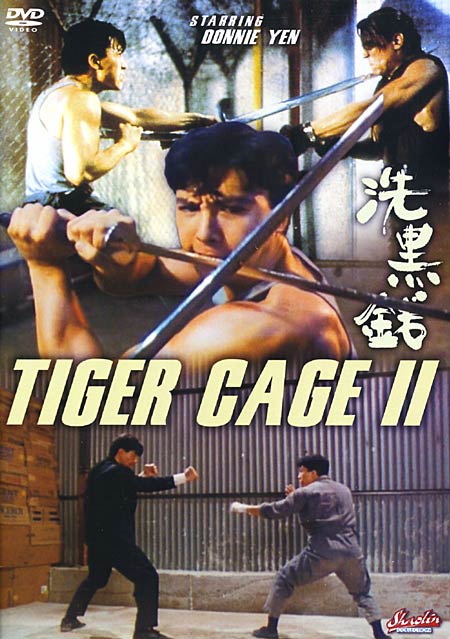
In the eighties, director and martial arts choreographing god Yuen Woo Ping was trying to push forward in the limelight one of his most gifted disciples, Donnie Yen. First, Yen worked for Yuen as a stuntman, then the pair collaborated on three urban action films under the banner of the ill-fated D&B Films Company: Tiger Cage, In The Line Of Duty 4 and Tiger Cage 2. The latter only has a vague thematic kinship to Tiger Cage: it is not properly speaking a sequel, as Donnie Yen doesn’t even play the same character. Or does he? The truth is, in those late-eighties thrillers Yen always played more or less the same character: a tough, naively macho cop, with an almost childish inability to properly communicate with women. Here he is surrounded with a fairly interesting cast including Shaw Brothers legend Lo Lieh, future Once Upon A Time In China star Rosamund Kwan, the highest-paid actress in Hong Kong (at the time) Carol “Do-Do” Cheung, as well as the Michelle Yeoh-wannabe Cynthia Khan and Robin Shou of Mortal Kombat fame.
Posted by LP Hugo on November 6, 2011
https://asianfilmstrike.com/2011/11/06/tiger-cage-2-1990-review/
THREE KINGDOMS: RESURRECTION OF THE DRAGON (2008) review
The Romance of the Three Kingdoms, the historical novel written by Luo Guanzhong in the 14th century and chronicling the years of constant warfare between kingdoms that marked the end of the Han Dinasty from 169 to 280, has always been the source of many films and TV series, most notably John Woo’s Red Cliff parts I & II, and a few months ago the Donnie Yen vehicle The Lost Bladesman. A sprawling epic, it provides a bonanza of characters, events and battles, which means filmmakers can always come back to the tried and tested Three Kingdoms source material, each time focusing on a different set of characters or a different chunk of the storyline.
Daniel Lee’s Three Kingdoms : Resurrection of the Dragon follows Zhao Zilong, one of the “Five Tiger Generals” of the Shu Kingdom. The film fashions itself as a biopic of sorts, but takes more than a few liberties with the source material, which itself is already semi-mythical. We follow Zhao Zilong (Andy Lau) from his enlisting in the Shu army, where he forms a long-standing friendship with Luo Ping An (Sammo Hung Kam-Bo), to his becoming a general nicknamed “The Invincible”, to his heroic death during the Battle of the Phoenix Heights, where his outnumbered army was annihilated by Cao Ying’s (Maggie Q) Wei Army.
Posted by LP Hugo on October 9, 2011
https://asianfilmstrike.com/2011/10/09/three-kingdoms-resurrection-of-the-dragon-2008-film-review/
PHANTOM: THE SUBMARINE (1999) review
Submarine films don’t come often: the last significant one was David Twohy’s superb Below in 2003 (and, the same year, Kathryn Bigelow’s underrated K-19: The Widowmaker). Asian submarine films are even more scarce. In fact, I can’t think of one on the top of my head. Phantom: The Submarine thus has some measure of novelty to it. Directed by Min Byung-Chun and written by the great Bong Joon-Ho (of The Host and Memories of Murder fame, among others), it stars Jun Woo-Sung and Choi Min-Soo. The plot is kind of a cross between The Hunt for Red October and Crimson Tide: a nuclear submarine commander (Choi Min-Soo) decides to go rogue and threatens to bomb a nearby country (here Japan), like Sean Connery in Red October. But not everyone agrees with him aboard the ship, which leads to a face-off between the commander and one of the officers (Jun Woo-Sung), like Gene Hackman and Denzel Washington in Crimson Tide. But Phantom: The Submarine has a tone all of its own, sometimes verging on the supernatural. The submarine in the film is called Phantom for one good reason: it’s not supposed to exist, and everybody in its crew is supposed to be dead. For instance Jun Woo-Sung’s character was supposed to be executed, but instead got assigned to the submarine as a weapons officer, under the number (names and personal items are forbidden) 431. So it’s basically the contemporary, realistic equivalent of a ghost ship.
Posted by LP Hugo on September 25, 2011
https://asianfilmstrike.com/2011/09/25/phantom-the-submarine-1999-film-review/