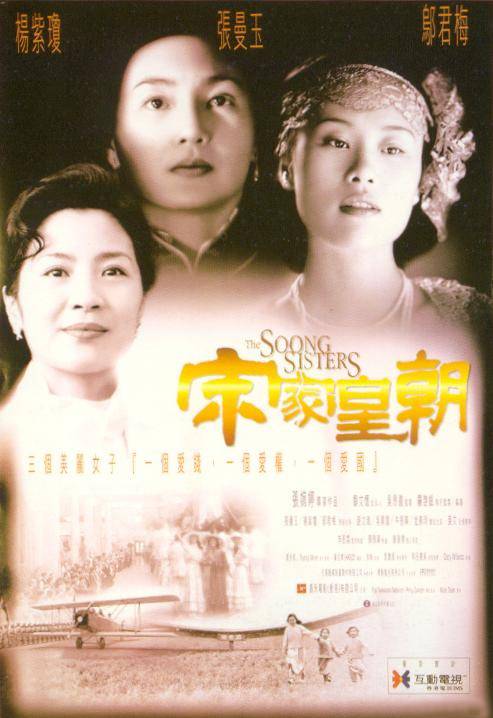
THE SOONG SISTERS (1997) review

tumblr_ni8z9gQbg71qzogw6o1_500

Mabel Cheung’s The Soong Sisters, though a bit forgotten nowadays, was a momentous project and an awards magnet at the time of its making and release, coming out in the year of Hong Kong’s retrocession to China and raking in Hong Kong Film Awards (or nominations) for most of its key players. It cast three of the most high-profile Asian actresses at the time as the titular sisters : daughters of catholic missionary, printing magnate and political activist and revolutionary Charlie Soong (Jiang Wen), himself a figure worthy of a 4-hour film, they each married a major figure of that infinitely troubled and transformative time in China’s history. Elder sister Ai-Ling (Michelle Yeoh) married H. H. Kung (Niu Zhenhua), one of the biggest fortunes in China and the future minister of industry, commerce and finance in the Kuomintang (Nationalist Party) government. Then her sister Ching-Ling (Maggie Cheung) wedded the revolutionary saint and first president and founding father of the Republic of China, Sun Yat Sen (Winston Chao), a union that estranged her from her outraged father, himself a close friend of Dr. Sun. And finally, youngest sister Mai-Ling got married to Sun Yat Sen’s ally and successor as head of the Kuomintang and as president of the Republic of China, Chiang Kai-Shek (Wu Hsing-Kuo). Each of these marriages took a toll on the family’s unity, but more importantly, the Soong sisters were much more than simply wives of powerful men. They were powerful women whose choices and sacrifices helped shape China’s history. Think of them as 20th-century women general of the Yang family.
Read the full post »

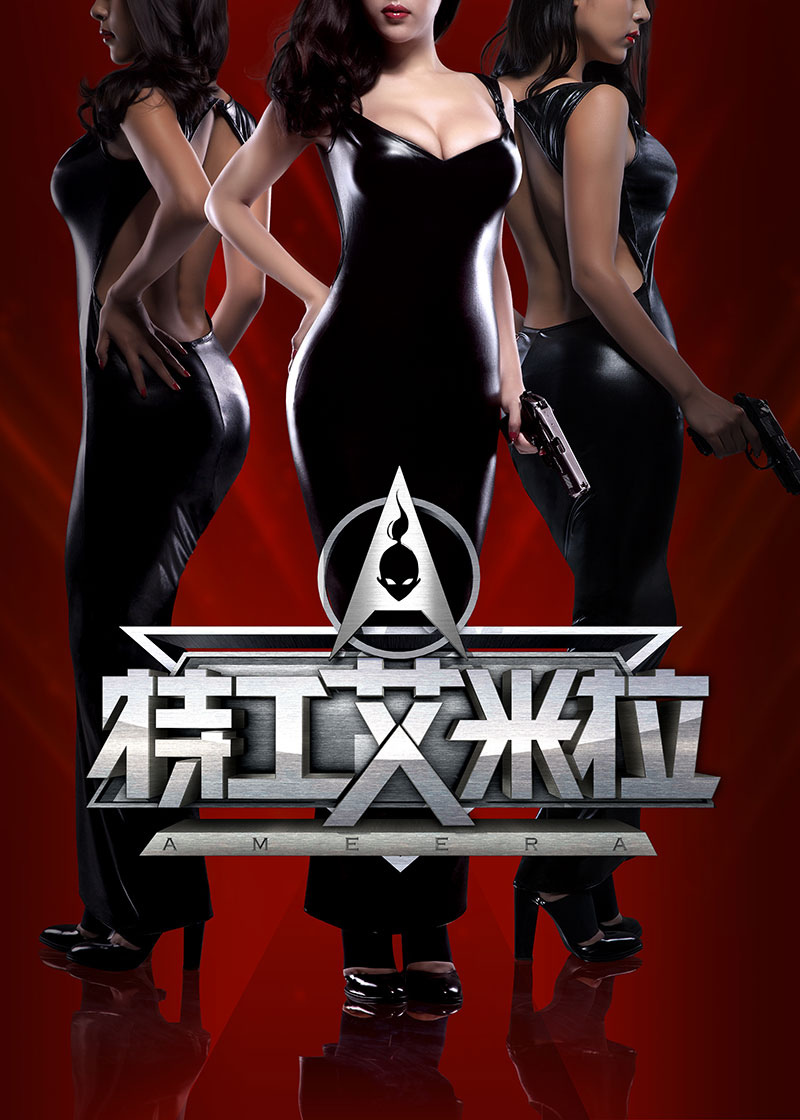
AMEERA (2014) short review

100200888043_590912_1010

Where to begin with a film like Xiao Xu’s Ameera. Or rather, how to end as quickly as possible. A deadening excuse for ogling would-be starlet Patricia Hu (whose only other notable film is the equally numbing Angel Warriors) as she essays an array of slinky “secret agent” outfits to fight a stock evil organization (headed by Andrew Lin and a cartoonish old cripple with hooks for hands) for which she finds out her boyfriend (Ambrose Hsu) is a double-agent. Along the way there’s talk of such things as “a micro laser device condensed from synthesized nanometers”, which wouldn’t be such a bad thing if the film didn’t take itself so very seriously, no mean feat considering it consists in eye-gouging CGI, fussy, weightless fights and endless moping sessions. Adding insult to injury, the film’s soundtrack is actually a collage of tracks from other, far more entertaining and satisfying films (music from the Bourne trilogy, The Expendables and Tony Scott’s Déjà Vu is heard repeatedly), and there are fleeting cameos by estimable martial arts actors Collin Chou and Leung Kar Yan, who could have alleviated the awfulness had they had more screen-time. 1/2*

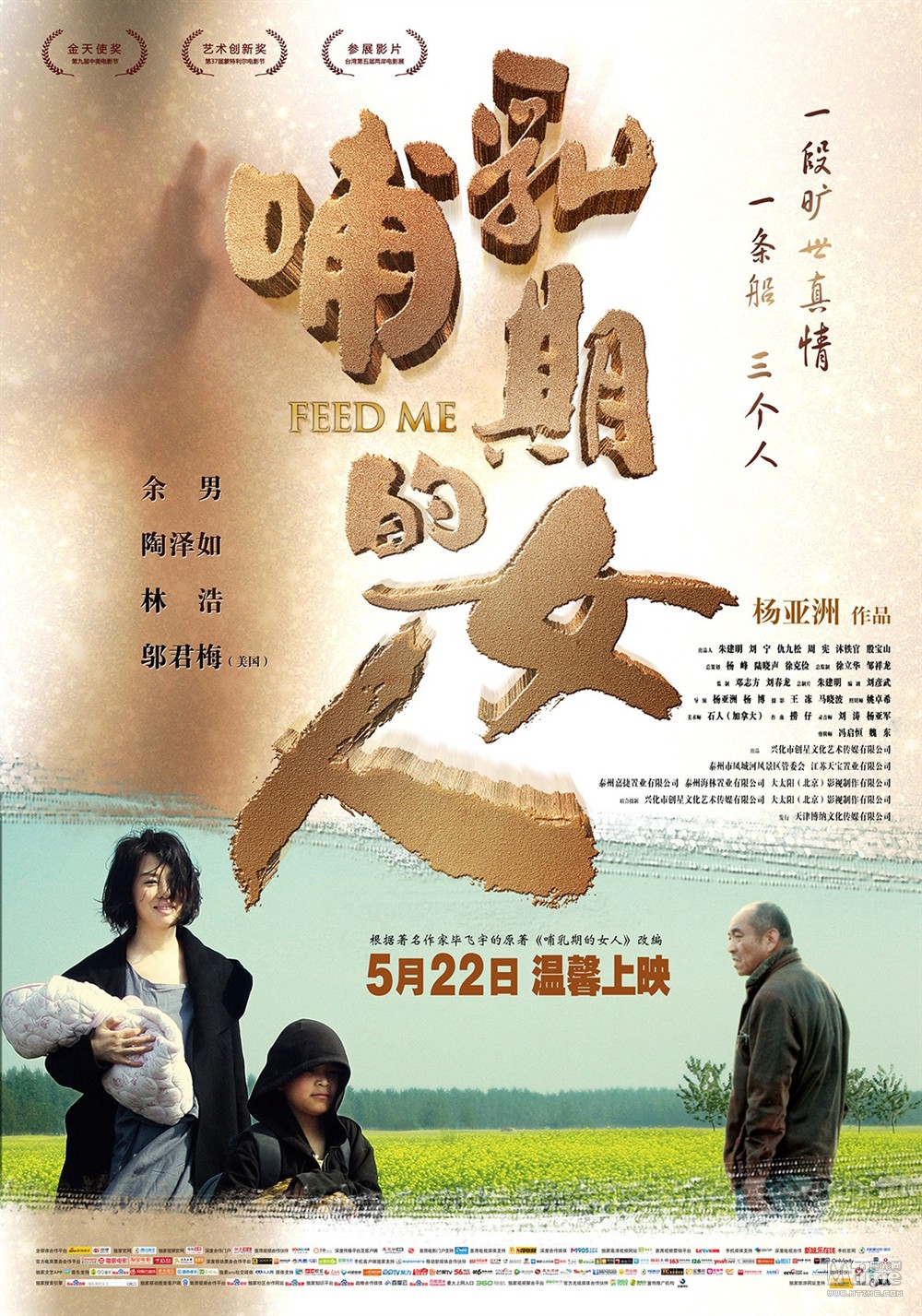
FEED ME (2015) review

145352.19295991_1000

Shot in 2012 but only released 3 years later, perhaps because of lead actress Yu Nan’s heightened profile after being in two of the biggest Chinese hits of the past months (Tsui Hark’s The Taking of Tiger Mountain and Wu Jing’s Wolf Warrior), Yang Yazhou’s Feed Me also bears the distinction of starring Lin Hao, a boy who had become a national hero after rescuing several of his classmates in his collapsing school building during the devastating Sichuan earthquake of 2008. The hero-turned-actor plays a country boy who lives with his grandfather (Tao Zeru) on a boat, making regular trips to Shanghai to sell rapeseed. It is on one of those trips that upon returning to the boat, they find a pregnant woman (Yu Nan) who seems to be running away from something or someone. Soon she gives birth, and the grandfather lets her stay onboard both for the sake of the baby and because he’s been diagnosed with early senile dementia and worries as to who will take care of his grandson when he no longer can. But in the nearby village there’s gossip and disapproval of this situation, especially from a doctor (Vivian Wu) he is trying to woo. As for the boy, he grows more and more fascinated by this woman he sees as a  potential surrogate mother.

Read the full post »

GOOD-FOR-NOTHING HEROS (2012) short review

maxresdefault

Fu Yong’s Good-For-Nothing Heros (a misspelling that doesn’t seem to be of the ironic “Inglourious Basterds” kind) tells of Peng (Kimi Qiao) and Long (Lam Suet), two amiable losers who find the lost will of a wealthy hotel owner (Kent Cheng), who just fell into a coma. They decide that Peng will pose as the owner’s son and leverage his new-found clout to save their neighborhood from relocation. But one big obstacle in the owner’s associate Danny (Francis Ng), who smells a rat and sends a private eye (Jack Kao) to check on Peng’s background. Beyond the crippling implausibility of the plot, what makes Good-For-Nothing Heros sink so far below average is its total lack of a pace, its muddled exposition, its often sappy tone and its incredibly tired gags. Seeing Lam Suet in a lead role is a real pleasure and gives the film what little spark it possesses, especially as he gets to share an underdeveloped but quietly offbeat romantic subplot with Christy Chung, in a rare turn as a plain (well, as plain as the stunning Chung can appear : make-up can only go so far), frumpy, big-hearted street food vendor. Unsurprisingly, Francis Ng knows what kind of film he’s in, and does some charismatic sleepwalking. *1/2

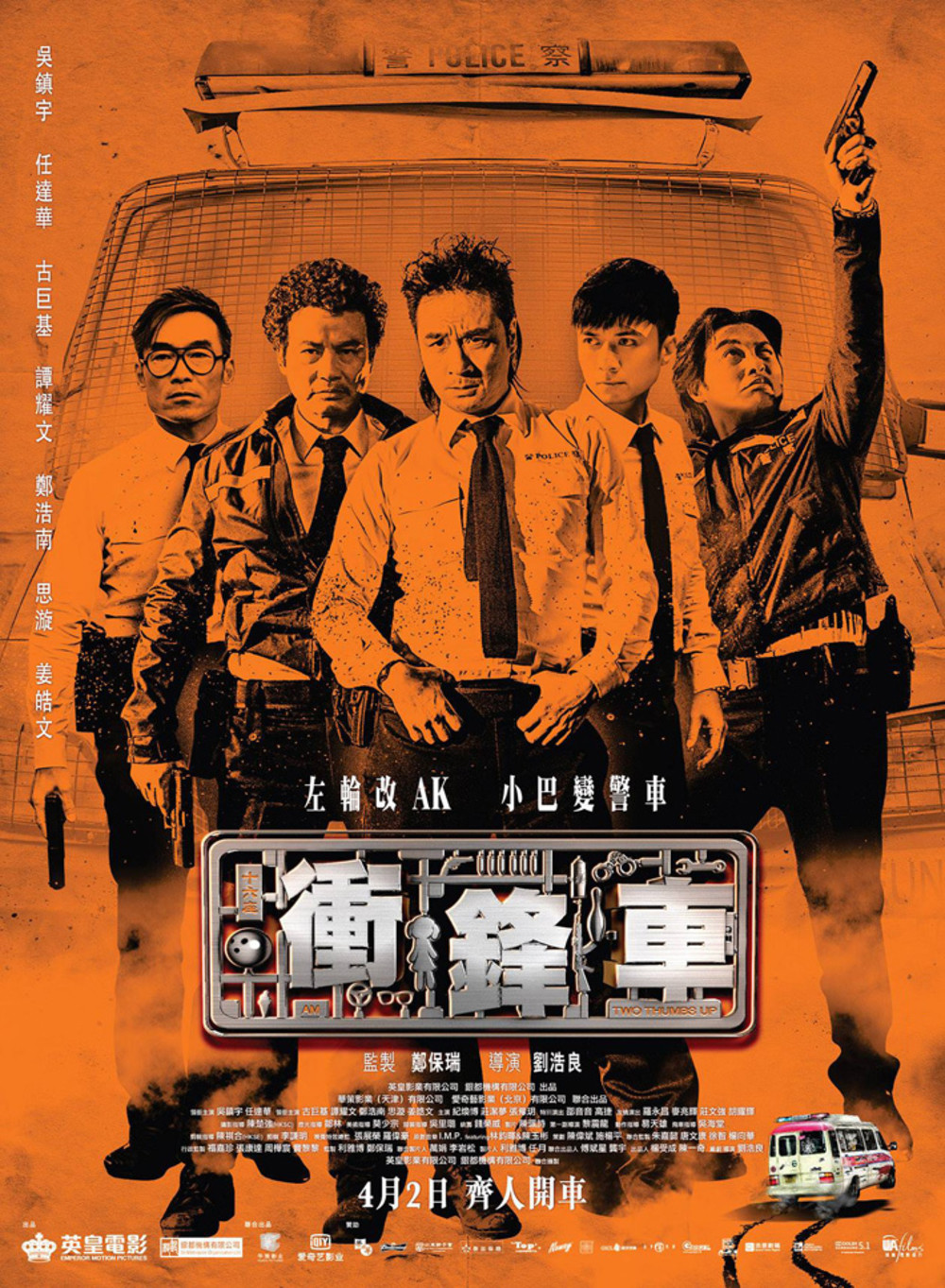
TWO THUMBS UP (2015) review

Two_Thumbs_Up

With Two Thumbs Up, screenwriter Lau Ho Leung makes his directorial debut after writing quite a few prominent Chinese/Hong Kong films for people like Derek Yee, Daniel Lee, Gordon Chan and Dante Lam, among others. It’s a film that commands a lot of upfront goodwill by being part of a dying breed, an all-Hong Kong film not calibrated in any way to appeal to the Mainland, and also by casting a quartet of Hong Kong staples: Simon Yam, Francis Ng, Mark Cheng and Patrick Tam. They play four ex-criminals who decide to come back to their old ways when one of them hatches a plan he thinks is foolproof : steal a Police Emergency Unit van, dress as cops, then rob anyone that comes their way all the more easily, especially a shady funeral service that smuggles money through the border by hiding it in corpses. In the absence of an actual EU van, the plan is put into execution by painting a mini-bus, and soon the four friends are cruising Hong Kong as fake cops. But unexpectedly, they end up fighting for justice : after saving a girl from rape, they run afoul of another team of crooks (who have the same plan of disguising as cops but decidedly more ruthless methods) and decide to stop them. Meanwhile, a young cop (Leo Ku) is hot on their trail.

Read the full post »

SIFU VS VAMPIRE (2014) review

sh-sifuvsvampire-23october2014

Amazingly, Daniel Chan Yee Heng’s Sifu vs Vampire is Hong Kong legend Yuen Biao’s first lead role in a feature film since Ricky Lau’s Hunted Hunter in 1997. We could imagine a better comeback vehicle than a crass Wong Jing-produced comedy, but we’ll take what we can get. Yuen plays Master Chiang, a Taoist priest and exorcist who together with his disciple Lingxin (Jiang Luxia) teams up with a pair of hapless gangsters (Ronald Cheng and Philip Ng) to fight – and sometimes fall in love with – vampires old and new. There’s a definite throwback quality to the film, as it harks back to the vampire comedies of the eighties and beginning of the nineties, most notably the Mr Vampire series which already featured Yuen Biao. Contrary to Juno Mak’s impressive Rigor MortisSifu vs Vampire is straightforward and unpretentious, a loosely calibrated mix of (very) broad laughs, (very) mild scares and (very) sparse fighting.

Read the full post »

LOVERS & MOVIES (2015) short review

Lovers-and-Movies-2015-1

Niu Chaoyang’s Lovers & Movies is one of those all-star Valentines Day cash-ins based on the blueprint of Gary Marshall’s Valentines Day : criss-crossing love stories across generations, played out by a few stars out for an easy paycheck. And so here we have a fifty-something woman (Kara Hui), who finds out her husband (Simon Yam) is having an affair, while her son is getting into bad ways and pushing away his girlfriend. Also, a cab driver (Francis Ng) is in love with a dance teacher (Yu Nan), whose five year-old son needs snow to win over a girl he likes at school. And a fangirl (Gulnazar) gets to meet her heartthrob idol (Kim Bum), after which they fall in love. It all unfolds in impossibly trite fashion, as platitudes about love are spoken in every scene over a treacly score, and grand romantic gestures are performed in ways that are often actually more creepy than endearing : witness Gulnazar barging in on a film scene being shot in a studio by the man she loves, by jumping off a wall, strapped on cables, with a red streamer that says ‘I love you’. Someone call the cops. The cast, which could have saved the film, is too uneven to manage that. Kara Hui and Yu Nan valiantly try to make unlikable characters worth sticking with, but Francis Ng expresses most emotions by smiling weirdly, and Simon Yam gives a performance so listless he probably took this film as a break from acting. And out of decency, let’s not mention the rest of the cast. *1/2

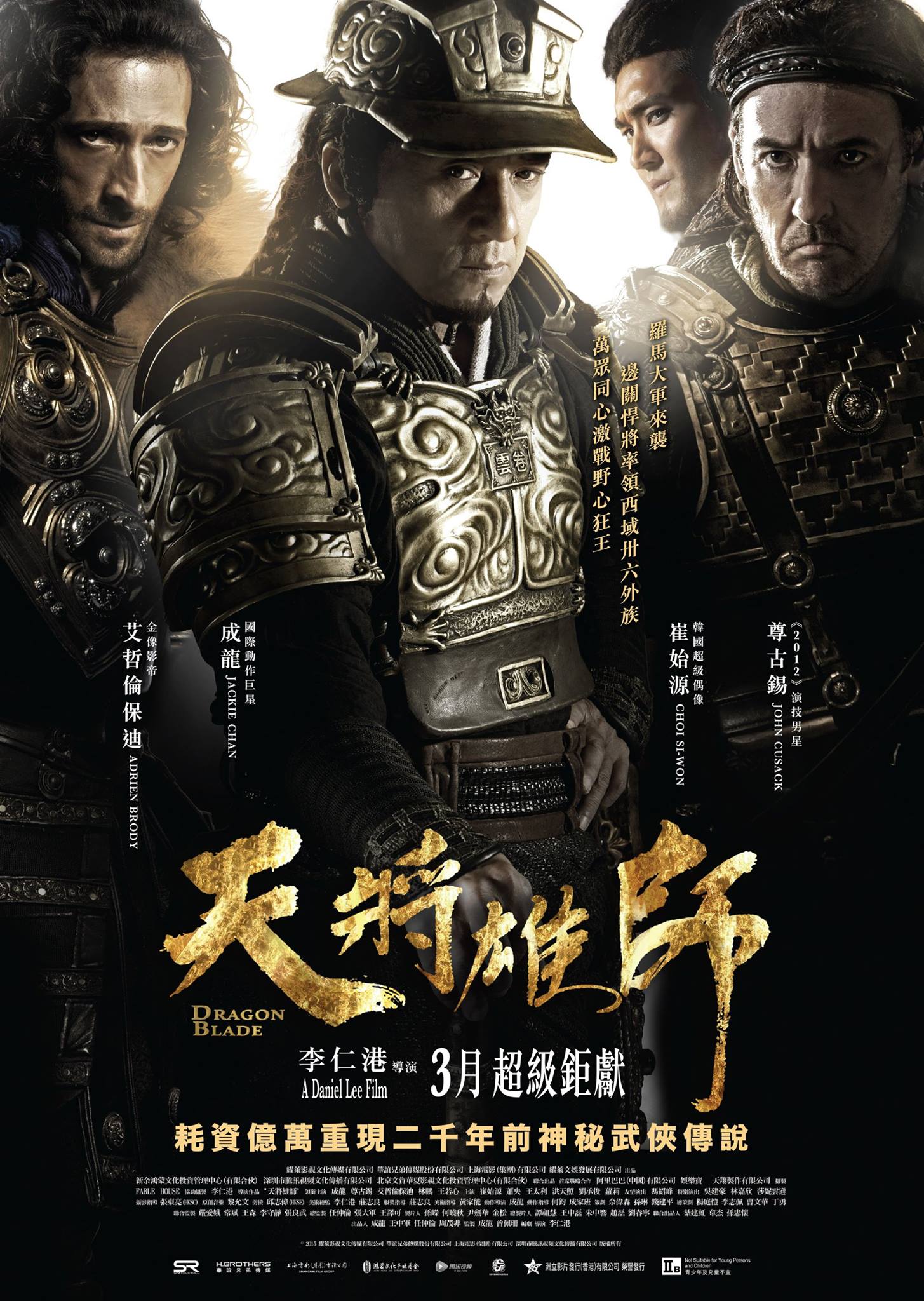
DRAGON BLADE (2015) review

Dragonblade

Note: This is a review of the original, 127-minute cut of the film screened throughout Asia. The international cut runs about 20 minutes shorter and cripples the film. Avoid watching it first if you can.

Daniel Lee’s Dragon Blade isn’t just another Chinese period epic. Its price tag of 65 million dollars makes it the most expensive Chinese film in history, while its opening numbers at the domestic box-office broke records and its final take of 120 million dollars ranks it as the 8th highest-grossing Chinese film. Its cast is truly international : gathered around Chinese A-listers Jackie Chan, William Feng and Karena Lam are Hollywood actors John Cusack and Adrien Brody, Korean actors/pop stars Choi Si Won and Steve Yoo, Australian dancer and scream queen Sharni Vinson, as well as French singer Lorie Pester. And its plot takes considerable licence with history to imagine a meeting of East and West, between the Roman armies and the tribes of Western China.

Read the full post »

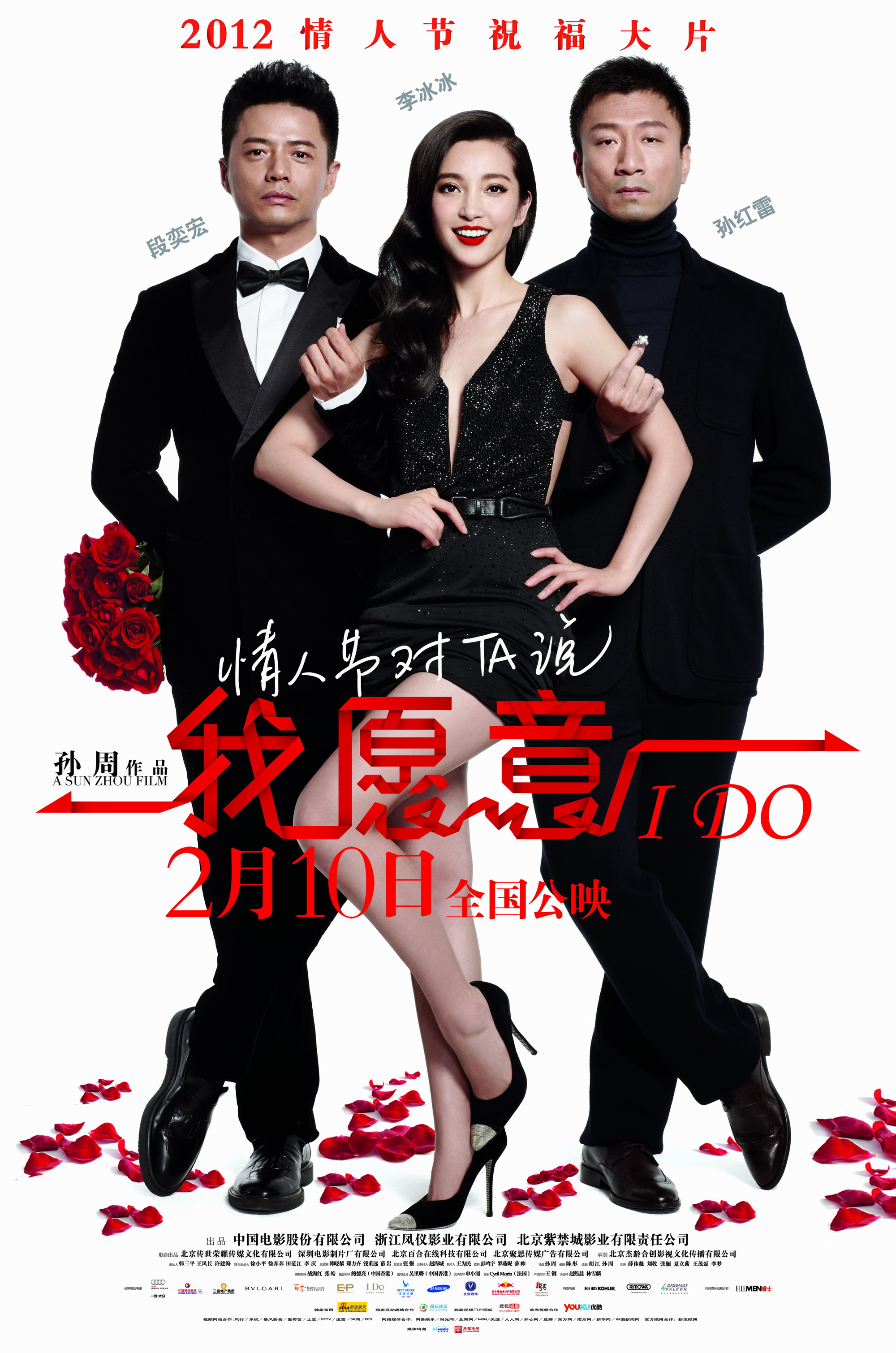
I DO (2012) short review

00190346

Sun Zhou’s I Do follows Tang Weiwei (Li Bingbing), a thirty-something business woman who’s given her all to her career, neglecting her love life after being left heartbroken a decade before by her boyfriend Wang Yang (Duan Yihong), a struggling graphic designer she had supported through difficult times. Now she’s finally ready to get in a relationship again, and in comes Yang Nianhua (Sun Honglei), a former publisher gone bankrupt, whose easy-going charm and selfless devotion make him a prime suitor. But things get complicated as Wang Yang suddenly reappears in Weiwei’s life : now a wealthy businessman, he plans to win her back. It’s the tried and true rom-com formula of the woman torn between two opposites: here, the rich old flame or the modest but charming new leaf. The dilemma unfolds in a thuddingly talky way, each of the usual stakes (does wealth matter more than devotion, can we forgive someone who’s broken our heart once, etc…) being discussed at length against the backdrop of fancy restaurants, sleek offices and luxury apartments, while several subplots involving under-developped supporting characters either fall flat or go nowhere. And if I Do remains watchable, it’s because it has in Li Bingbing a lead actress of tremendous class and subtlety, whose chemistry with Sun Honglei (in a full-on charm attack) and Duan Yihong (excellent in a more thankless role) is immaculate. Would that all romantic comedies had such appealing leads. **1/2

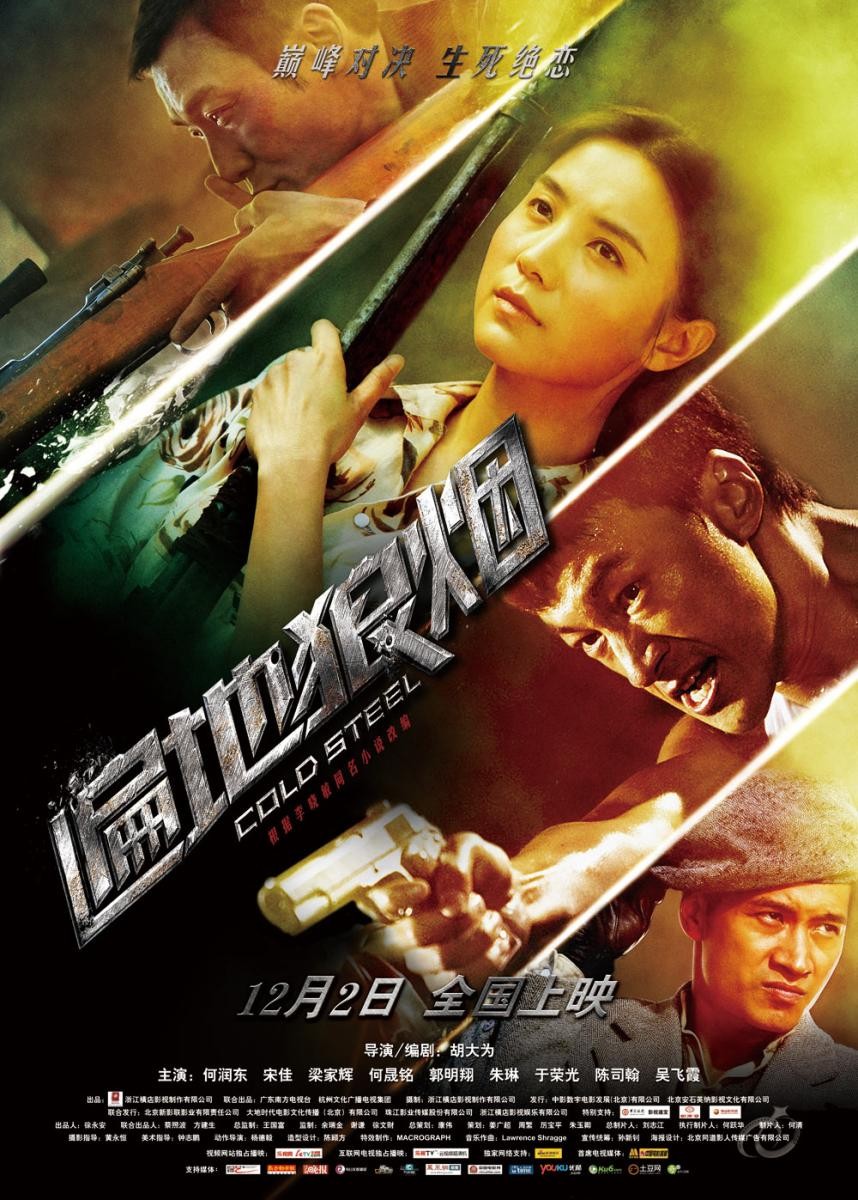
COLD STEEL (2011) review

cold-steel-poster

As an editor, David Wu Dai Wai has had an illustrious career, cutting together the films of John Woo, Tsui Hark, Johnnie To, Ann Hui and many others. As a director, his list of credits is more modest, comprised as it is of mainly American TV movies and a few fairly unsuccessful Hong-Kong films (with the exception of The Bride With White Hair 2 in 1994). Cold Steel is actually his first Mainland film as a director, and is adapted – by Wu himself – from a popular 2009 novel by Li Xiaomin. Set in central China in 1938 during the Sino-Japanese war, it follows a young hunter, Mu Liangfeng (Peter Ho), who falls in love with Liu Yan (Song Jia), a woman whose teahouse has been turned into a temporary infirmary. But soon, Mu is enrolled by force in a sniper unit after using his marksmanship skills to rescue a Nationalist Army convoy from a Japanese sniper attack. The unit is headed by the grizzled veteran Zhang Mengyi (Tony Leung Ka Fai), and its new assignment is to assassinate four Japanese generals in the city of Jingzhou, to slow down the Japanese army. After the mission goes awry, they manage to escape but a Japanese colonel (Wilson Guo) is tasked with hunting them down with his own sniper squad.

Read the full post »